B2B SaaS · Work Management · Averon product
Trackly Work tracking that shows what has stopped, and who is expected to act.
Trackly is a work-tracking platform for operations teams. Alongside boards, lists, calendars and reports, it records who promised what, who is waiting on whom and which work has no owner, and gives managers a short, ranked list of exactly those problems.
- Status
- Web and mobile applications built
- Surfaces
- Web app · Android & iOS app · Background worker
- Owner
- Averon Technologies
The problem
Why Trackly exists
Most task boards show what work exists, not what has stalled. When a deadline moves, the old date is overwritten. When someone is blocked, it lives in a comment. Unassigned jobs go unnoticed until someone scrolls through every card. Managers find problems by hunting for them.
Built for
Operations-led teams coordinating many jobs at once across people and outside parties.
What it does
Key capabilities
Needs attention
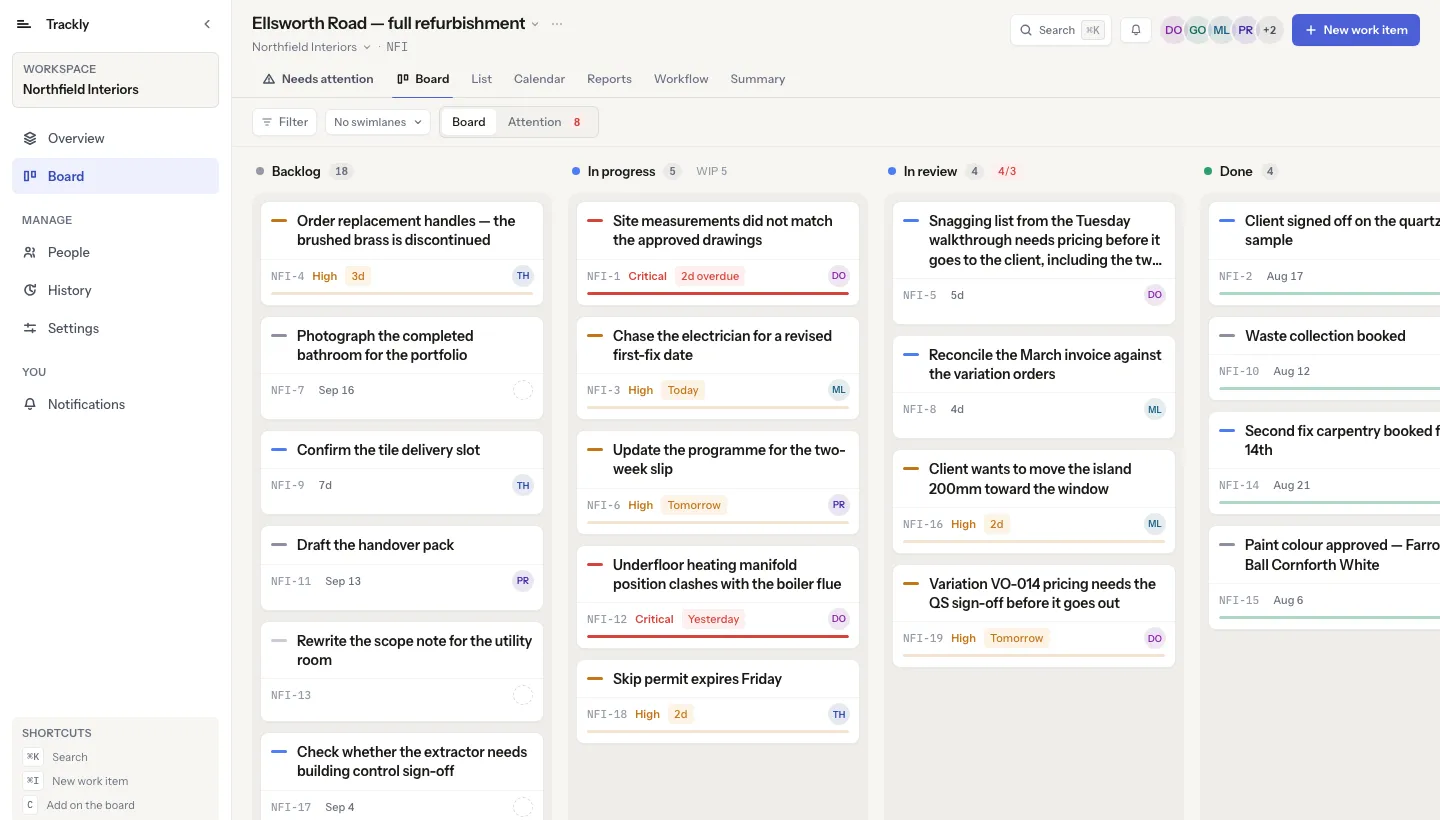
A ranked list capped at seven items, with an exact count of the rest, covering unanswered commitments, unacknowledged waiting, unowned work and moved dates. Every entry names the record that put it there; there are no opaque scores.
Commitments that keep their history
Ask someone to commit to a date and only they can accept, decline or propose another. When a date moves, the original is kept alongside the new one and the reason.
Waiting as a first-class record
Blocked work names what it is waiting on (a colleague, a supplier or another job) with a start time and an age, and ends explicitly instead of disappearing into a comment.
Columns with fixed meanings
Teams name their own workflow columns, but each maps to not started, in progress, waiting or done, which is what lets Trackly tell slow work apart from stuck work.
Evidence-grounded briefing
An operational briefing computed deterministically first. An AI model may only phrase findings it can cite, and the briefing stays useful with the model switched off.
Web, mobile and full history
A web app and a Flutter mobile app, in-app, email and push notifications, role-based access, and a complete change history with time-in-stage reporting.
Engineering highlight
The AI may propose language. It may not manufacture truth.
Trackly's briefing separates what is true from how it is said. A deterministic analysis computes every finding and number first; the model receives only an evidence package bounded by what the reader is allowed to see; and a validator rejects any draft that cites something it was not given. Findings load in milliseconds while the narrative follows seconds later, so the page is useful from the first frame, and a refused explanation is shown as exactly that.
Where it stands
Web and mobile applications built
Trackly's web application, mobile application and API have been built. Public availability has not yet been announced.
Built to last
- Customer data isolated at the database level, not only by application filters
- Every change recorded with who and when; administrative history kept separately
- Notifications delivered through a restart-safe queue with safe retries
- Automated contract checks stop the web app, mobile app and API drifting apart
Technology
- Next.js
- React
- TypeScript
- Fastify
- tRPC
- PostgreSQL
- Drizzle ORM
- Redis
- BullMQ
- Flutter
More products
Discuss your project
Tell us what you need to build and we will talk through the scope, architecture and how an engagement could be structured.
Start a conversationRelated services